
The Setup: A Question of Boundaries
We like to draw lines. It’s human nature to categorize who is “in” and who is “out,” deciding exactly how much of ourselves we are willing to give before it becomes too inconvenient.
An expert in the law tried to do exactly that with Jesus. He stood up to test Him, asking a straightforward question: “Teacher, what must I do to inherit eternal life?”
Jesus points him right back to the law: “What is written in the Law? How do you read it?”
The man responds with the ultimate standard: “Love the Lord your God with all your heart and with all your soul and with all your strength and with all your mind; and, Love your neighbor as yourself.”
Jesus tells him he answered correctly—”Do this and you will live.” But the man wanted a loophole to justify his own limitations. He asks, “And who is my neighbor?”
He wanted a boundary line. Instead, Jesus gave him a mirror.
The Road to Jericho
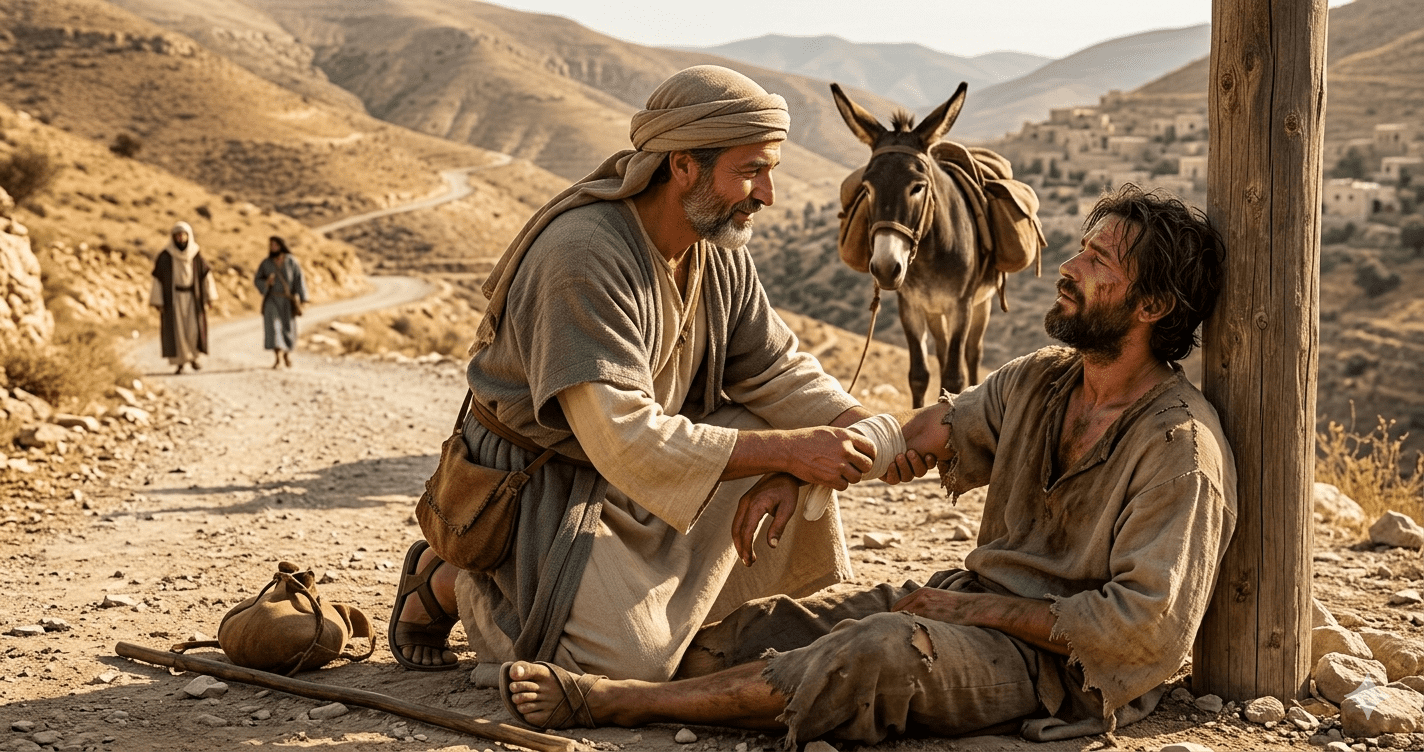
Jesus responds with a stark story: “A man was going down from Jerusalem to Jericho, when he was attacked by robbers. They stripped him of his clothes, beat him and went away, leaving him half dead.”
Two religious insiders—the people you would expect to step up—happen to be going down the same road. A priest comes by, sees the man, and passes by on the other side. A Levite does the exact same thing. They had their reasons. Maybe it was ritual purity, maybe it was fear, or maybe they were just busy.
Then comes the outsider. “But a Samaritan, as he traveled, came where the man was; and when he saw him, he took pity on him.”
In that culture, Samaritans and Jews didn’t mix; the animosity ran deep. Yet, this man didn’t look for a reason to avoid the mess. He leaned into it. He went to him, bandaged his wounds, pouring on oil and wine. Then he put the man on his own donkey, brought him to an inn, and took care of him. The next day he handed two denarii to the innkeeper and said, “Look after him, and when I return, I will reimburse you for any extra expense you may have.”
Mercy Without Borders
At the end of the story, Jesus turns the question back on the legal expert: “Which of these three do you think was a neighbor to the man who fell into the hands of robbers?”
The expert can’t even bring himself to say the word “Samaritan.” He just replies, “The one who had mercy on him.”
Jesus gives a direct command that cuts straight through our excuses today: “Go and do likewise.”
Being a neighbor isn’t about proximity, shared culture, or comfort. It’s a deliberate choice to show mercy, smash through cultural prejudices, and take action when someone else is broken. It means opening our eyes to the people we normally look right past and going the extra mile, even when it costs us something.
“Go and do likewise.” — Luke 10:37
Scripture Reference: Luke 10:25-37